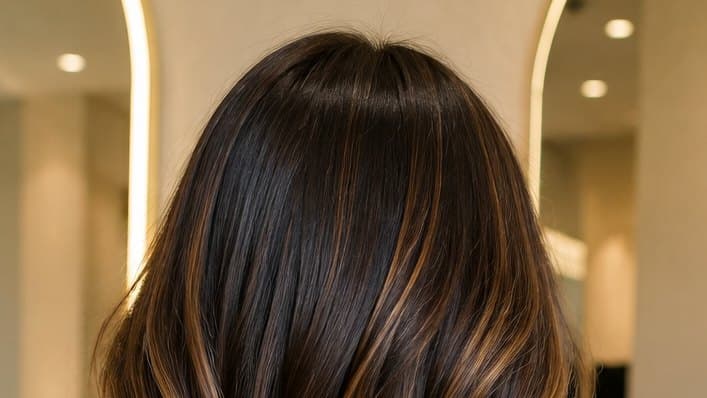
Types of hair: a visual guide to your natural pattern
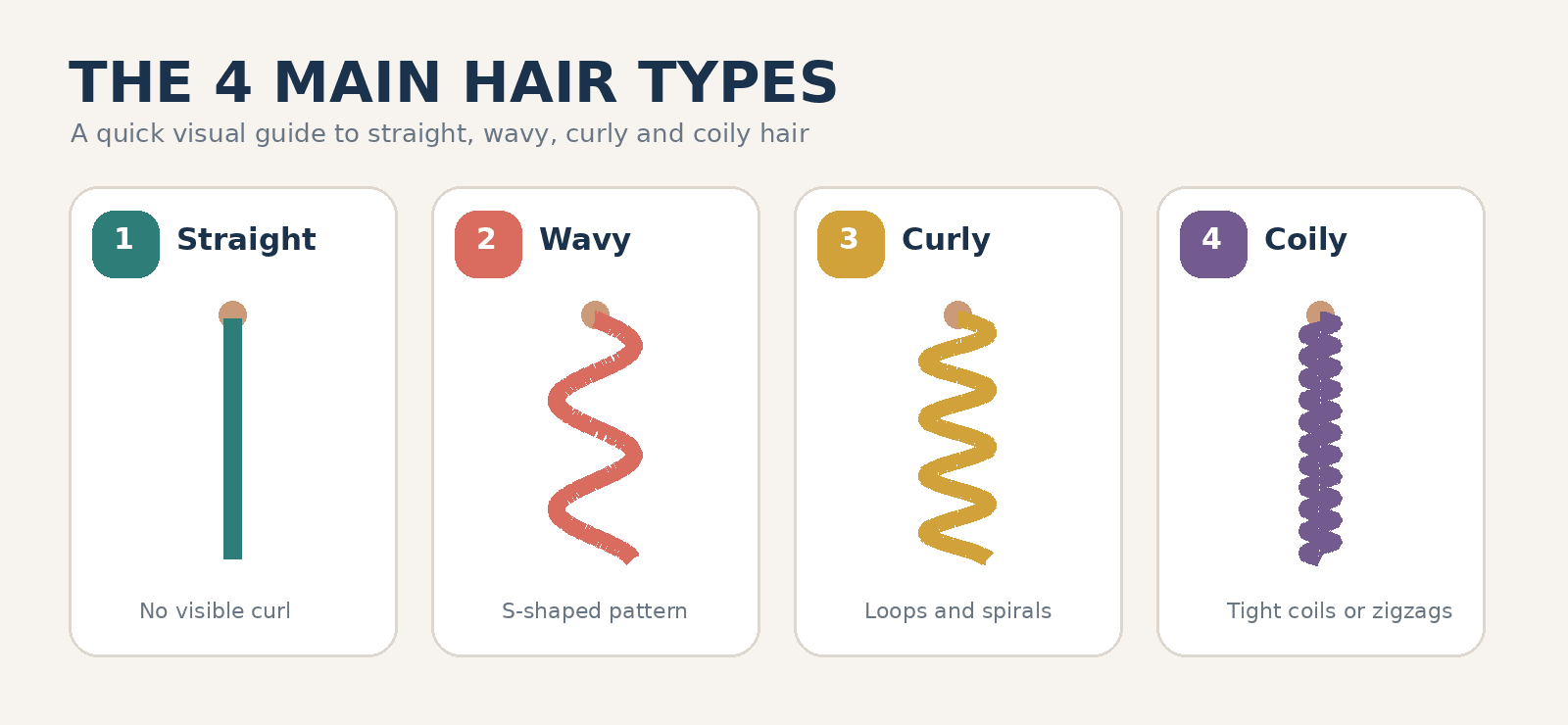
Hair is commonly grouped into four main pattern families: straight, wavy, curly, and coily. Each family also has A, B, and C subtypes that describe how loose or tight the pattern is. Knowing your type isn't about labels for their own sake — it tells you why your hair behaves the way it does, and which products and routines will actually work for it.
How to identify your natural pattern
- Wash your hair and skip the styling products.
- Let it air-dry without brushing it straight.
- Watch what the strands do: stay straight, or form waves, loops, or tight coils.
Type 1: straight hair
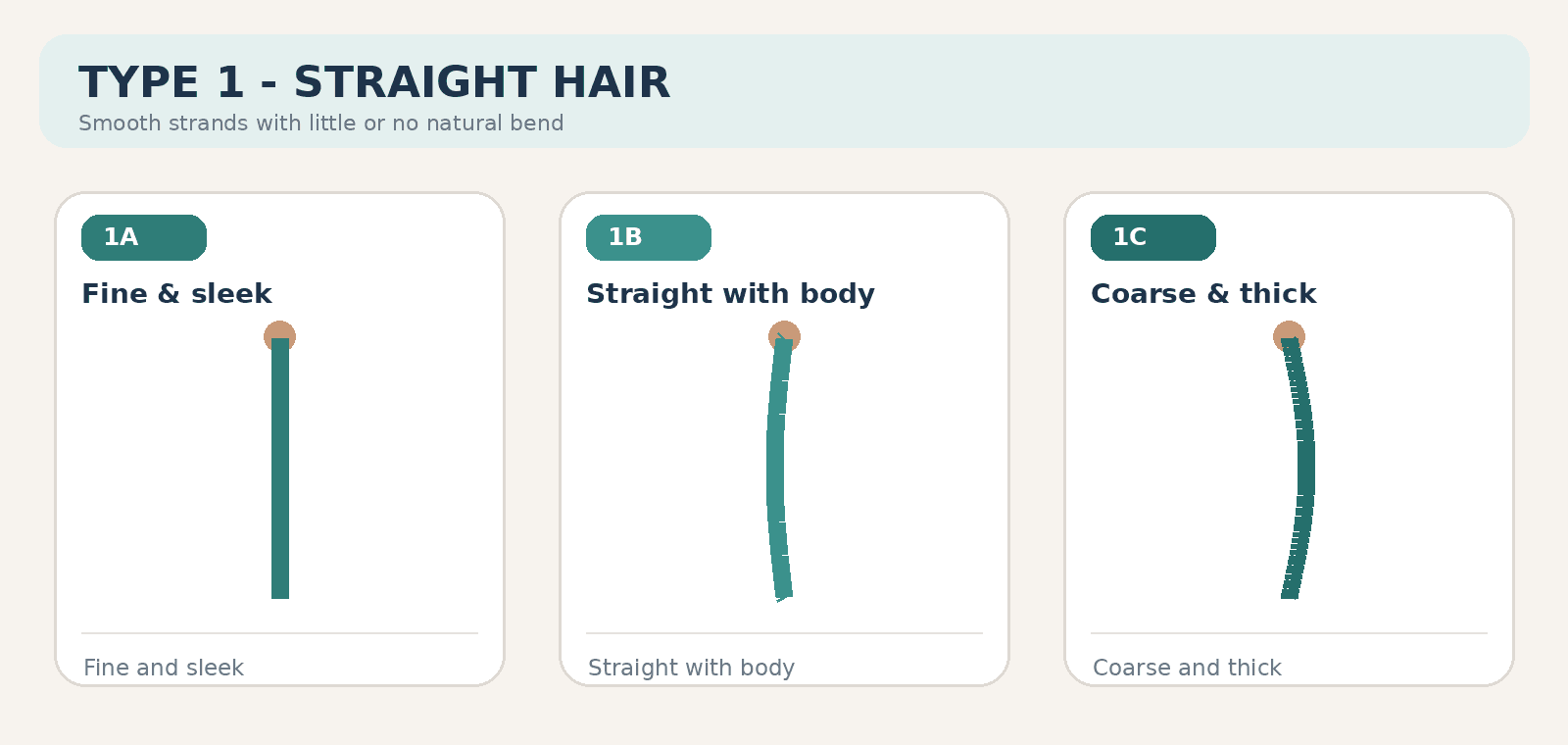
Straight hair falls from the roots with little or no visible wave. Scalp oils can travel easily down the strand, so this type often looks smooth and shiny. The subtypes run from 1A (fine and sleek) through 1B (straight with body) to 1C (coarse and thick).
- Usually easy to comb and detangle
- May become oily or flat quickly
- Fine strands may not hold curls for long
- Type 1C can be thicker and more prone to frizz
Simple care routine
- Choose a lightweight shampoo and conditioner
- Apply conditioner mainly to the lengths and ends
- Use small amounts of serum or oil
- Add mousse or dry shampoo when you need extra volume
Best approach
- Keep products light. Too much oil, butter, or heavy cream can make straight hair look greasy or limp.
Type 2: wavy hair
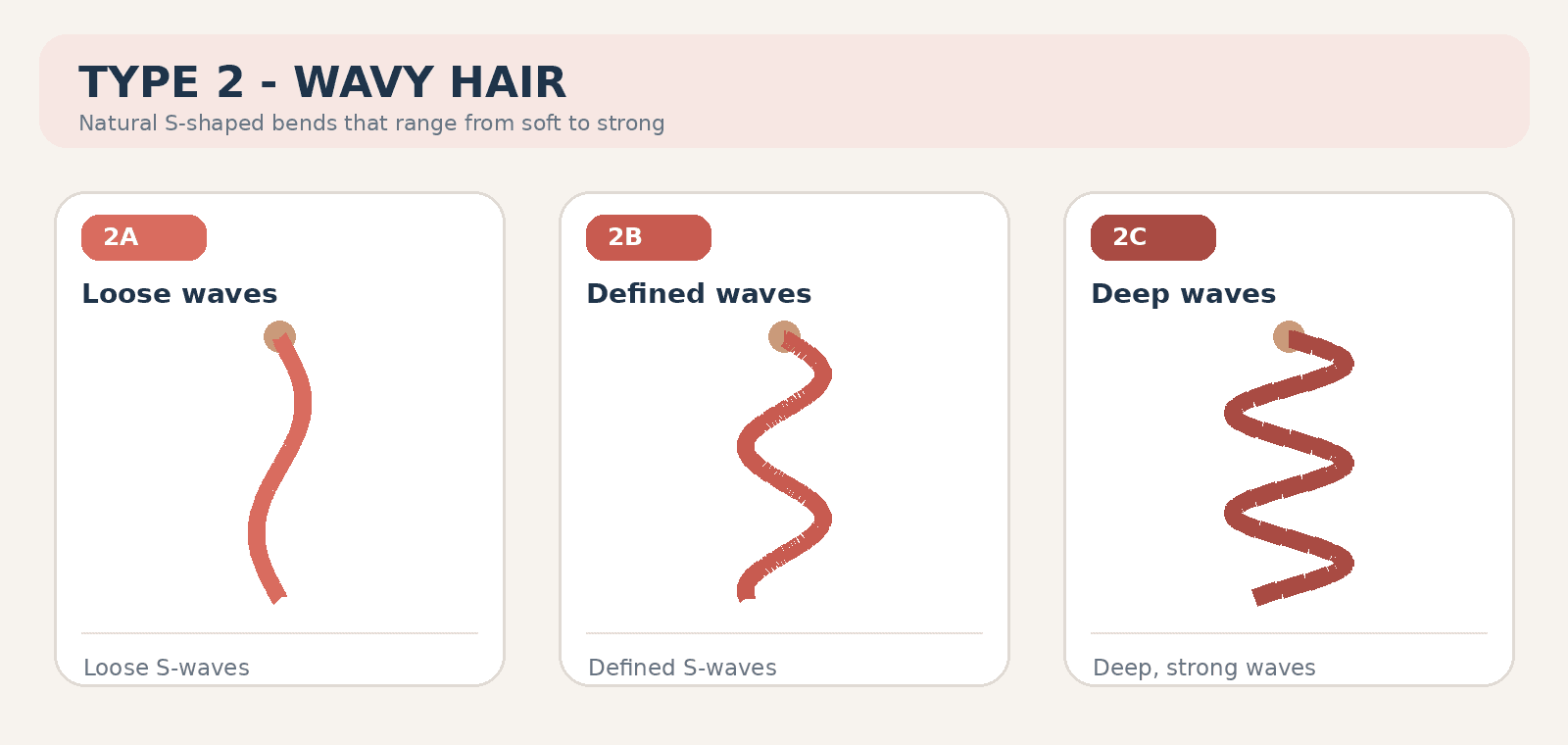
Wavy hair forms an S-shaped pattern. It sits between straight and curly, with anything from loose bends (2A) to defined waves (2B) to deep, almost-curly waves (2C).
- More body than straight hair
- Can become frizzy in humid weather
- Heavy products may pull the waves down
- Different areas of the head may have different wave strength
Simple care routine
- Use a lightweight conditioner, mousse, or gel
- Scrunch gently while the hair is damp
- Dry with a soft T-shirt or microfibre towel
- Avoid repeatedly brushing the hair once it's dry
Best approach
- Encourage the wave without weighing it down. Start with a small amount of product and add more only where needed.
Type 3: curly hair
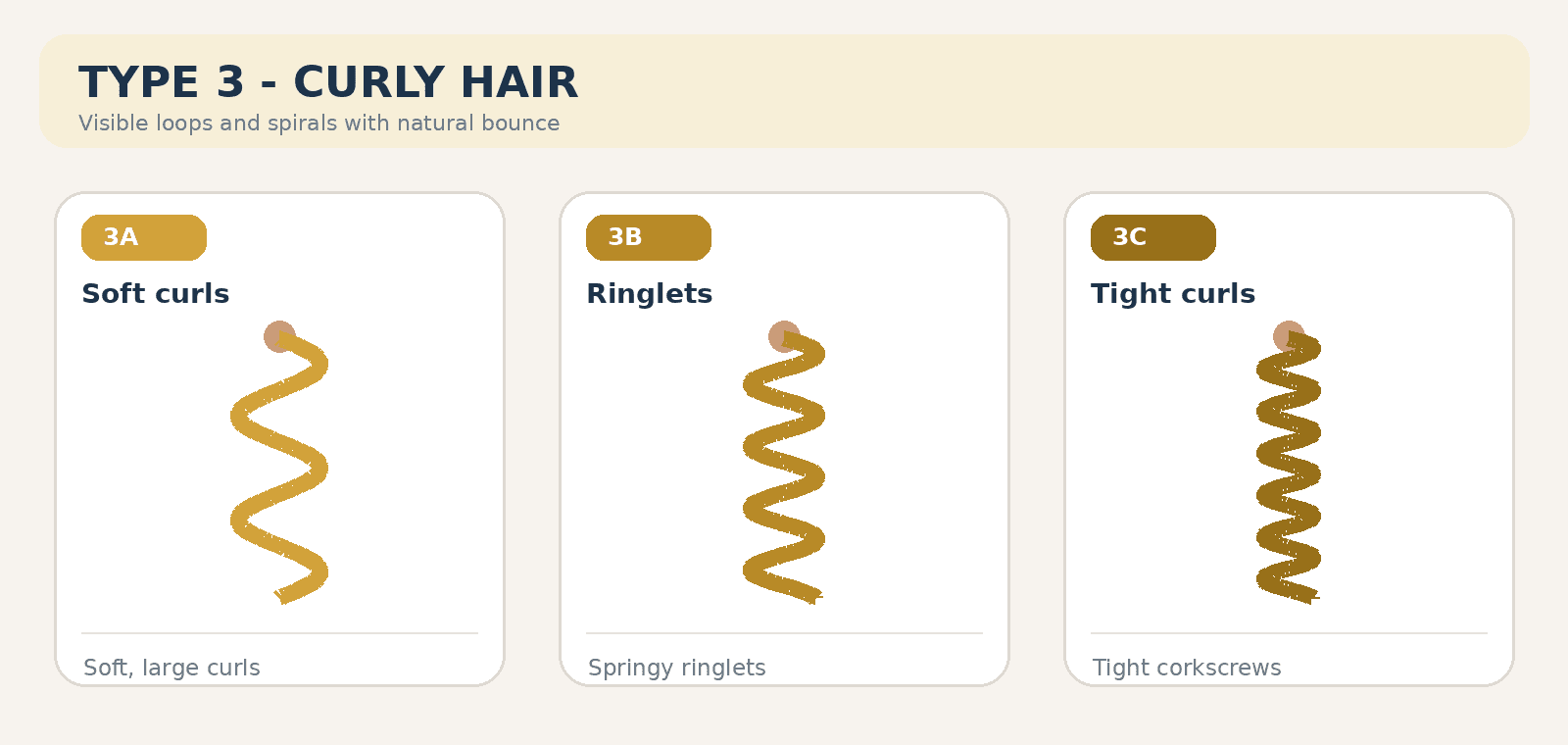
Curly hair forms visible loops, spirals, or ringlets — from soft, large curls (3A) through springy ringlets (3B) to tight corkscrews (3C). The curved shape makes it harder for natural oils to reach the ends, so moisture and gentle handling matter most.
- Naturally bouncy and voluminous
- May shrink noticeably after drying
- Often becomes dry or frizzy
- Can tangle or break when handled roughly
Simple care routine
- Use a moisturising conditioner regularly
- Detangle when damp and coated with conditioner
- Use fingers or a wide-tooth comb
- Limit high heat, and don't brush dry curls
Best approach
- Protect the curl pattern. Gentle detangling, moisture, and minimal friction usually improve definition and reduce breakage.
Type 4: coily hair
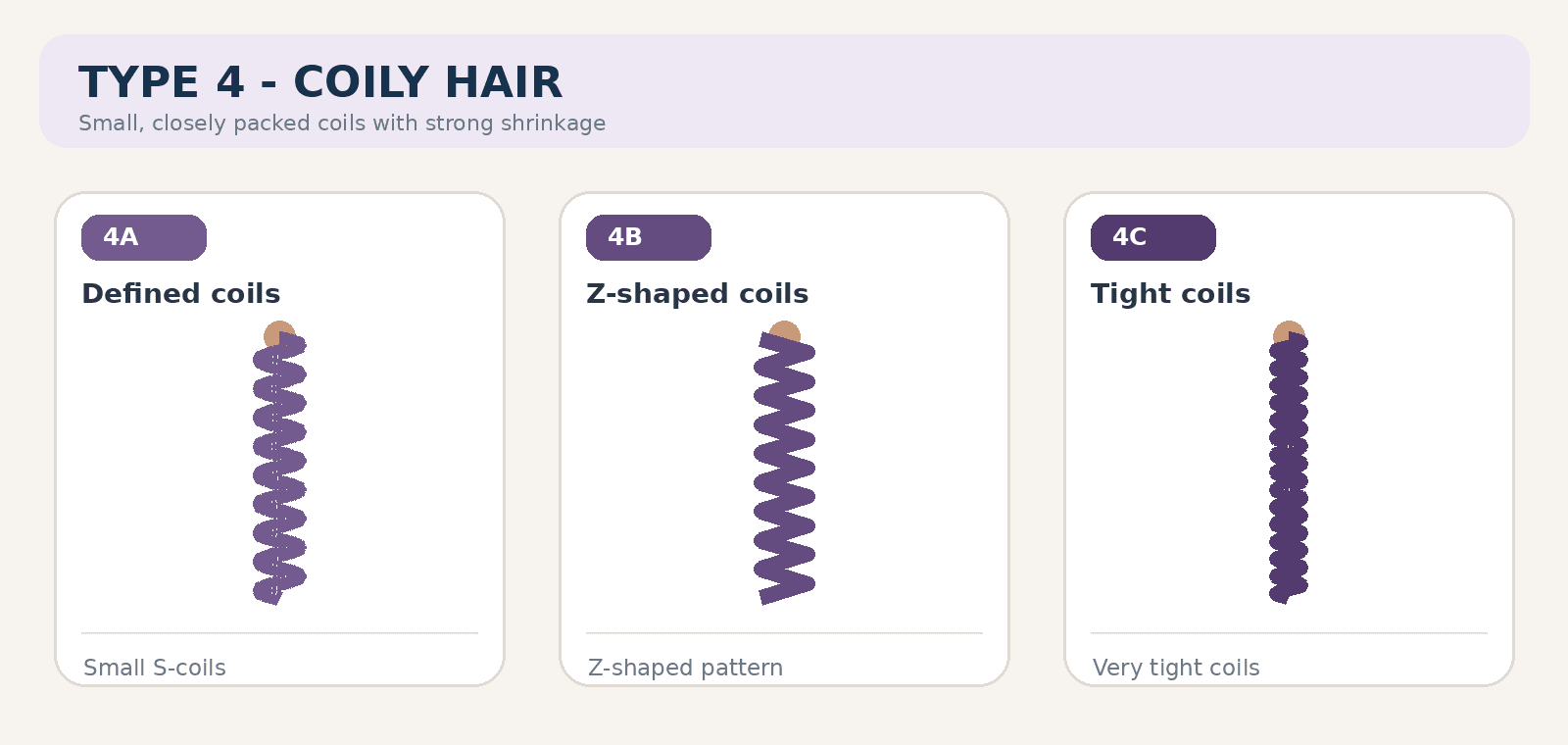
Coily hair has very small curls, tight spirals, or zigzag patterns — defined S-coils (4A), Z-shaped patterns (4B), or very tight coils (4C). It can look strong and full, but individual strands are often delicate and prone to dryness.
- High natural volume and significant shrinkage
- Needs regular moisture retention
- Can tangle easily
- Ends may be especially fragile
Simple care routine
- Deep-condition and use a leave-in product
- Detangle in small sections, from ends to roots
- Use creams or oils to help seal in moisture
- Choose protective styles that are comfortable, not tight
Best approach
- Focus on moisture and low manipulation. Protective styling helps, but tight braids or extensions can stress the scalp and hairline.
Pattern is only one part of your hair type
Two people with the same curl pattern can still need different routines. Three more factors shape what your hair wants:
- Thickness
- Fine, medium, or coarse — the diameter of each strand
- Density
- Low, medium, or high — how many strands grow on the scalp
- Porosity
- How easily hair absorbs and holds on to moisture
Remember
- Your scalp may carry more than one texture — most heads do.
- Thickness, density, and porosity affect product choice as much as the curl pattern does.
Quick comparison
| Hair type | Natural pattern | Moisture need | Main care focus |
|---|---|---|---|
| Straight | No visible curl | Usually lower | Oil control and volume |
| Wavy | S-shaped bends | Moderate | Lightweight definition |
| Curly | Loops and spirals | Higher | Moisture and gentle detangling |
| Coily | Tight coils or zigzags | Highest | Moisture retention and low manipulation |
Every hair type is beautiful
- The goal is not to change your natural texture — it's to understand it and care for it well.
Find a stylist who knows your texture
A good stylist adjusts everything — the cut, the products, even how they section and dry — to your pattern, thickness, and porosity. Meilo ranks hair stylists by the quality of their actual work, so you can see how they handle hair like yours before you book.
Thinking about colour next? Start with what balayage actually is, or see our monsoon hair care guide for humidity-proof routines.
Before you book
- How do I find out my hair type?
- Wash your hair, skip all styling products, and let it air-dry without brushing. Whatever the strands do on their own — stay straight, bend into waves, loop into curls, or form tight coils — is your natural pattern.
- What do the letters A, B, and C mean in hair types?
- They describe how loose or tight the pattern is within each family. A is the loosest (like 2A loose waves or 3A soft curls) and C is the tightest (like 2C deep waves or 4C very tight coils).
- Can I have more than one hair type on my head?
- Yes — most people do. It's completely normal for the crown, sides, and nape to carry different textures. Pick routines for the pattern that dominates, and adjust product amounts area by area.
- Why does curly and coily hair get so dry?
- Natural scalp oils travel easily down a straight strand but struggle to follow bends and coils, so the ends of curly and coily hair receive less oil. That's why moisture — conditioners, leave-ins, sealing creams — is the core of curly and coily care.
- What is hair porosity?
- Porosity is how easily your hair absorbs and holds on to moisture. Low-porosity hair resists water and products sitting on top; high-porosity hair absorbs quickly but loses moisture just as fast. It affects product choice as much as your curl pattern.
- Is it bad to brush curly hair?
- Brushing dry curls breaks up the pattern and causes frizz and breakage. Detangle when the hair is damp and coated with conditioner, using fingers or a wide-tooth comb, working from the ends up.